A few weeks ago, Sherry Marr at Poets United asked if I would do and interview with her. It appeared today on their website. Thanks, Sherry, for the opportunity! If you’re interested, you can read it here.
Category: Uncategorized
Her Scream Is Not Enough
I tried to find a line in this incredible piece to give you a taste of Rajani Radhakrishnan’s poem. But each line is so breathtaking that it must be swallowed whole.
a waking dream.
Beth is able to see the world through a child’s eyes and to translate it for us mere mortal adults. Today she has found stories by refugee children to share. An incredible project by a journalist working with refugees, and a direct way we can help these kids find a way home. Here’s the direct link to the book ($10) on Amazon.


A collection of fairy tales written by child refugees in Greece has gone on sale to help those like the book’s authors.
Travelling Tales features a rugby-playing dog, a king who grew to love animals and chickens fighting an alien invasion among its eight stories.
The book is the brainchild of Brazilian journalist Debora de Pina Castiglione and her sister Beatriz. The two combined their love of words and illustrations to create the book but the ideas came directly from the children.
Debora ran workshops with Syrian and Kurdish children aged between four and 14 years old, at three refugee camps close to Thessaloniki in Vasilika, Lagadikia and Oreokastro.
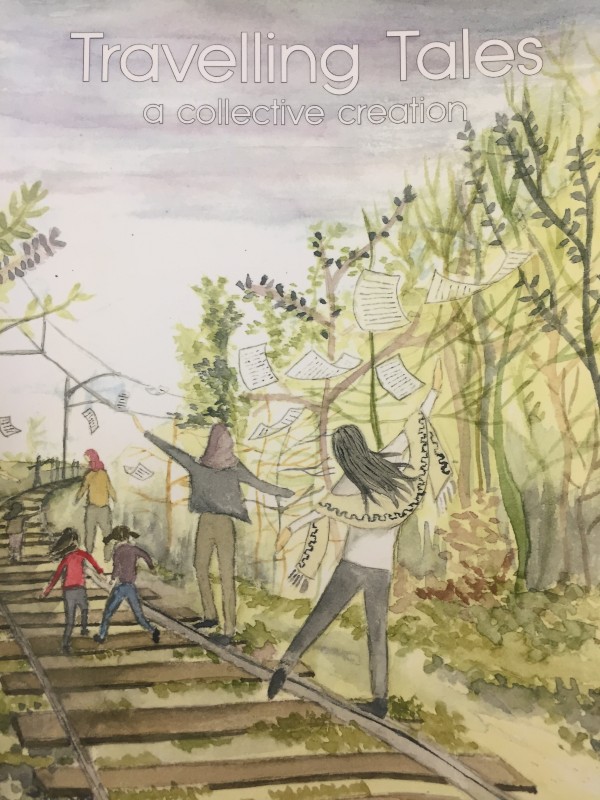
It gave the children something to do without focusing on their own lives.“The idea was not…
View original post 406 more words
god On The Morning Local
I want to share Rajani Radhakrishnan’s gentle poem about life and god and
how. . . well, how one thing leads to another.
Rust Belt
“. . .empty factories and gutted storefronts. . .”
Rust Belt
Sure, we loved the hats and hoopla
the rhythmic chants of lock her up,
but we are not a stupid people.
We know full well this patchy place
between the slag heaps
and the scrub pine–
these crumbling houses perched behind
the padlocked plant once known
for truck tires,
will never be great—
or even good.
You say rust belt
and mean the measure
of empty factories
and gutted storefronts.
The jobs bled out.
The eyesores left behind to moulder.
But the rust is mostly in us.
Too many years of children
born to little hope.
Too many years of promises
from windbags in dingy union halls
and air-conditioned buses
painted red, white, and blue.
This afternoon, I take my maul
to the wood pile
by the rusted chain link fence.
Crisp and clear,
It is a fine day to bust things up–
And the making
of that splintered shattered kindling
with a body that burns
is as near as I will ever come to joy.
– Steven Deutsch
First published in New Verse News
Chancing Love
Not a dive’s precision arc.
Instead a lemming run and plunge,
oblivious to depth,
temperature, whether
water’s in the pool.
Cynics shake their heads.
“Only a fool…” they say.
“Yes, yes!” I answer,
and drop my towel.
-Sarah Russell
First published in Shot Glass Journal
July 4th Memories
My friend John Ziegler posted this nostalgic look back at July 4th celebrations on Facebook. Hope you all enjoy it.
As kids we were keenly aware that the Fourth of July, had been federally designated to celebrate our nation’s independence so first thing that morning we put on our shorts, white tee shirts and Keds, ready to run fast, make noise and eat ice cream. Teddy and Frankie came to the back porch with green carbide canons, tubes of Bangsite, and strings of fire crackers Teddy smuggled from Canada during a fishing trip. We had sparklers and candy. There was always candy involved. Mr. Mallory’s Corner Grocery had glass cases dazzling with penny candy, so our pockets were sticky with sweet, colorful wads.
The next door neighbor had a vintage ice cream maker, with rotating wooden barrel, chain driven, filled with ice and rock salt that surrounded the steel canister of ingredients, cream, sugar, cherries or strawberries. The process started in the morning with the ice cream finally ready at dusk.
Eagerly awaited, this was a day of adventure. After a bike ride to the vacant field behind the Masonic Temple we lay in the warm grass watching clouds evolve. Out of curiosity and a rasher of bravado, Frankie laid a fire cracker across his sneaker and lit it with an Ohio Blue Tip. The fuse sparked, grew short, disappeared and when the little red tube exploded, Frankie jumped three feet and bellowed like a mule. He walked with a limp the next few hours but recovered by the time foot races began with Albert Cassone.
Albert Cassone was an odd man of sixty something who lived in a brick row house a couple of blocks down Franklin Street. Black business pants, pressed white shirt open at the collar and wing tip dress shoes he arrived in our back alley with a pocket full of coins to challenge any and all in a foot race to the third black tar line, for a dime. Everyone got in line, everyone ran faster than wind. Everyone got dimes.
Late in the day the parents whistled the family signal to come home for the picnic. We easily ate three or four loaded hot dogs from the charcoal grill, along with macaroni salad, baked beans, carrot strips, black olives followed by a couple of kinds of cake and finally the home made ice cream. We hardly ever threw up.
When the sky finally grew dusky, fireworks lit up the fairgrounds, loud and bright, concussions shook the air, clouds of smoke softly disappeared in the dark, the whole world drifted in a dream and the country was secured in independence for another year.
John Ziegler
The Thief
An allegory for our times.

Each day he took something. The right breast of the mother. The grandfather’s supper. The child’s teacher. Sometimes he’d leave something in exchange, but it was always lesser.
Selma’s black hair was replaced with gray. Over time, her brush stilled, her studio emptied. Once she heard the eagle’s cry and her heart opened like a red barn door, then the crack of a rifle and the door slammed shut. She kept one brown feather. During the days that grew windy and progressively darker, she’d stand at the window and run a finger up and down the feather, its softness a comfort, a reminder.
But still he took something beautiful and left something ugly. Civility became extinct, like the eagle and the wolf, and in its place was built a long wall separating her old country from her new one.
Without her art, she took to pacing her side of the…
View original post 364 more words
Everything Becomes a Stranger
“. . . a poem is a silent tree in spate . . .”
This morning I read a new poem by Rajani Radhakrishnan that is a perfect description of how a poem is made and who it becomes as we let it go. Rajani gave me permission to reblog it, so here it is. Please visit her site, ThotPurge to thank her, and while you’re there check out her second blog Phantom Road where she converses with Marcus in a series of haibun poems — equally as evocative. Rajani, I am so grateful to have discovered your poetry.
Everything Becomes A Stranger
even a word in a sentence,
you hold it there, lock it in and
for a while it makes sense
then it begins to work itself loose
wanting to move
wanting to move on
another appears in its place
an unfamiliar voice,
saying something else;
a poem is a silent tree in spate
one by one its green eyes fall
one by one new eyebrows are raised
only you know it is a different tree
the shadows paint another dark
and whatever is flowering
is not caused by your being;
everything becomes a stranger
once it leaves, once it falls
words, worlds,
people,
even you walking away
carrying a poem
carrying a sentence
cast shapes angled into the sun
as if the light is making love to you
in a different language.
– Rajani Radhakrishnan
Mademoiselle Boissière
“. . .roses dizzied her with summer. . .”
Ekphrasis is poetry is based on works of art. I love this kind of writing. This poem is based on “Mademoiselle Boissière Knitting” by Gustave Caillebotte.
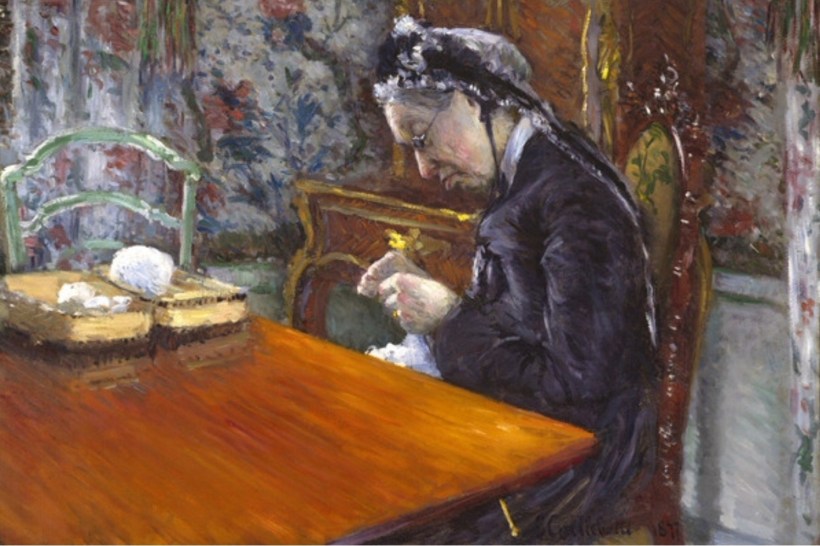
She sits alone
knitting for Sophie’s baby,
expected in the spring.
She doesn’t think of Sophie baring
herself for a man, as she did once,
when roses dizzied her with summer,
how easy her petticoats lifted, how
afterwards they smelled of blood
and sweat, how she stumbled,
pushed the bolt to lock the door,
how those smells return
when she sees him in the square,
squiring his wife on errands
and feels her heart loose
in its stays.
– Sarah Russell
First published in Ekphrastic Review
 Sarah Russell Poetry