The Cottage

“the smell of earth turned by a trowel…”

I’ve grown quiet here. My mind
has opened to woodsong
and the smell of earth turned
by a trowel.

I enjoy solitude, even when regrets
or the throb of an old lover happen by.
Sometimes I invite them in, make
a ritual of teacups on starched linen,
a silver server for the scones.
We reminisce ’til shadows trace
across the floor, call them away.

Afterwards, I tidy up, wipe away
drops spilled in the pouring. I save
the leftovers though they’re getting stale.
I may crumble them on the porch rail
tomorrow for sparrows
before I garden.

– Sarah Russell
First published in Poetry Breakfast

a waking dream.

Beth is able to see the world through a child’s eyes and to translate it for us mere mortal adults. Today she has found stories by refugee children to share. An incredible project by a journalist working with refugees, and a direct way we can help these kids find a way home.  Here’s the direct link to the book ($10) on Amazon.

beth's avatarI didn't have my glasses on....

Refugee children have written a book of fairy tales and it's just awesome
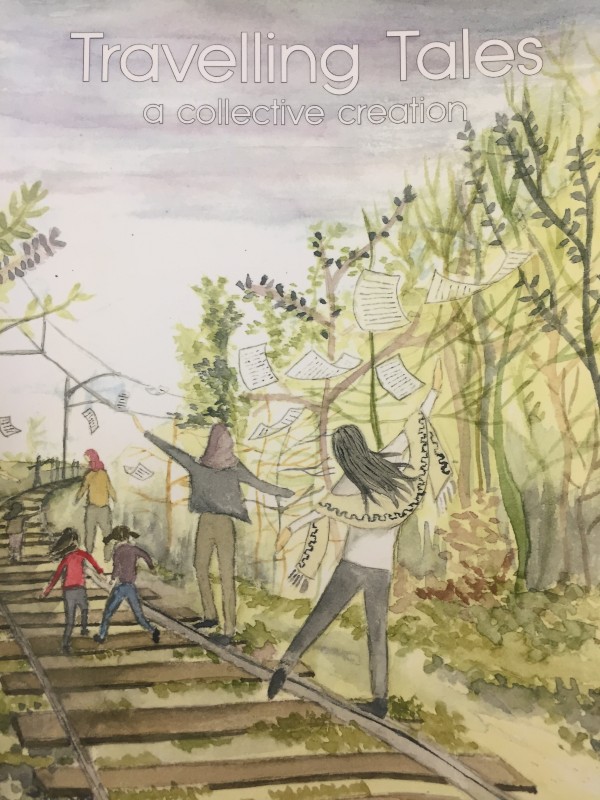
 Refugee children have written a book of fairy tales and it’s just awesome. Travelling Tales features chickens fighting an alien invasion among its eight stories.

A collection of fairy tales written by child refugees in Greece has gone on sale to help those like the book’s authors.

Travelling Tales features a rugby-playing dog, a king who grew to love animals and chickens fighting an alien invasion among its eight stories.

The book is the brainchild of Brazilian journalist Debora de Pina Castiglione and her sister Beatriz. The two combined their love of words and illustrations to create the book but the ideas came directly from the children.

Debora ran workshops with Syrian and Kurdish children aged between four and 14 years old, at three refugee camps close to Thessaloniki in Vasilika, Lagadikia and Oreokastro.

Front cover of Travelling Tales

It gave the children something to do without focusing on their own lives.“The idea was not…

View original post 406 more words

Dorothy’s Grave

“They haven’t dug the grave yet.”

Mom insisted on coming to the cemetery
after her best friend Dorothy’s viewing.
“The funeral’s not ’til 2 tomorrow,” I said.
“They’ll dig it in the morning.”

“They should have it dug,” she fussed.

Mom is a farm woman, used to death.
She turned ninety in the fall,
and Dorothy was her last good friend
in the tiny delta town where children leave
for jobs or school or just to escape the soy
and cotton. Her church has only twenty members
now — old women who show off corsages
on Mother’s Day and sometimes cajole their men
to come in overalls and slicked-back hair.

Dorothy and Mom taught Bible study, went to Eastern Star
and bingo, traded recipes and gossip.
Mom killed a rabid skunk in Dorothy’s yard
with the double barrel she keeps under the bed,
and Dorothy came to quilt on Wednesdays –
just the two of them since the other three passed on.

“Why’s it important to see the empty grave?” I asked.

“I need to know she’ll be comfortable,” Mom said.
“I know she’d do the same for me.”

– Sarah Russell
First published in On the Veranda

Stillborn

My friend Ryan Stone has a poem in the August issue of Red River Review.  I’ll reprint the poem as well as links both to his blog, Days of Stone, and to the journal.  Many fine poems on both venues.

Although science, with clinical wisdom
declared her not yet a person,
a heartbeat argued defiantly
for a night.

We visit the cemetery —
hands entwined, minds
in different hemispheres,
hearts mangled. In a quiet corner

where the sun lingers late in summer,
where gelid moans soften in winter,
we become broken pieces
of something once much stronger.

– Ryan Stone

Figure Drawing at Community College

This flash piece was just published in Rusty Truck.  Thanks, Scot!

~~~~~~~~~~~~~~~~~~~~~~~~~~~~~~~~~~~~~~~~~~~~~~~~~~~~~~~~~~~~~~~~~~~~~~~~

I’m getting goosebumps from a draft, though the class doesn’t notice. Most are open-mouthed, charcoal scratching paper, concentrating on the weight of my breast, curve of hip, sag of buttock. I bite my lip, think of the rigidity of a villanelle, try to compose one in my head while the old guy in a beret for god’s sake, studies the cleft, the pubic mound, then meets my eyes.

I want to yell, “I just want to earn enough to get cable,” but I look away, try to show disgust without showing disgust because the woman who will pick up kids from school at 4 is drawing my face. My arm is falling asleep. The instructor said to tell her when I need a break, but the young man by the window is so intent, I hate to interrupt him. I start to tremble, try to shift but not throw off the line. The villanelle becomes a limerick.

There once was a nude on a table
Who couldn’t afford to get cable…

Trembling. Can’t feel my arm at all.

She posed for a class
Where an old man was crass,

Ah, the instructor is announcing a break. I raise my body off my arm and feel electric shocks as blood starts to flow. I reach for my kimono. The old guy sidles up to me.

“Coffee later if you are able?” he asks. Shit, he’s finished my limerick. I walk away rubbing my arm. “Maybe tomorrow?” he calls.

– Sarah Russell

Rust Belt

“. . .empty factories and gutted storefronts. . .”

Rust Belt

Sure, we loved the hats and hoopla
the rhythmic chants of lock her up,
but we are not a stupid people.
We know full well this patchy place
between the slag heaps
and the scrub pine–
these crumbling houses perched behind
the padlocked plant once known
for truck tires,
will never be great—
or even good.

You say rust belt
and mean the measure
of empty factories
and gutted storefronts.
The jobs bled out.
The eyesores left behind to moulder.
But the rust is mostly in us.
Too many years of children
born to little hope.
Too many years of promises
from windbags in dingy union halls
and air-conditioned buses
painted red, white, and blue.

This afternoon, I take my maul
to the wood pile
by the rusted chain link fence.
Crisp and clear,
It is a fine day to bust things up–
And the making
of that splintered shattered kindling
with a body that burns
is as near as I will ever come to joy.

– Steven Deutsch
First published in New Verse News