July 4th Memories

My friend John Ziegler posted this nostalgic look back at July 4th celebrations on Facebook.  Hope you all enjoy it.

As kids we were keenly aware that the Fourth of July, had been federally designated to celebrate our nation’s independence so first thing that morning we put on our  shorts, white tee shirts and Keds, ready to run fast, make noise and eat ice cream. Teddy and Frankie came to the back porch with green carbide canons, tubes of Bangsite, and strings of fire crackers Teddy smuggled from Canada during a fishing trip. We had sparklers and candy. There was always candy involved. Mr. Mallory’s Corner Grocery had glass cases dazzling with penny candy, so our pockets were sticky with sweet, colorful wads.

The next door neighbor had a vintage ice cream maker, with rotating wooden barrel, chain driven, filled with ice and rock salt that surrounded the steel canister of ingredients, cream, sugar, cherries or strawberries. The process started in the morning with the ice cream finally ready at dusk.

Eagerly awaited, this was a day of adventure. After a bike ride to the vacant field behind the Masonic Temple we lay in the warm grass watching clouds evolve. Out of curiosity and a rasher of bravado, Frankie laid a fire cracker across his sneaker and lit it with an Ohio Blue Tip. The fuse sparked, grew short, disappeared and when the little red tube exploded, Frankie jumped three feet and bellowed like a mule. He walked with a limp the next few hours but recovered by the time foot races began with Albert Cassone.

Albert Cassone was an odd man of sixty something who lived in a brick row house a couple of blocks down Franklin Street. Black business pants, pressed white shirt open at the collar and wing tip dress shoes he arrived in our back alley with a pocket full of coins to challenge any and all in a foot race to the third black tar line, for a dime. Everyone got in line, everyone ran faster than wind. Everyone got dimes.

Late in the day the parents whistled the family signal to come home for the picnic. We easily ate three or four loaded hot dogs from the charcoal grill, along with macaroni salad, baked beans, carrot strips, black olives followed by a couple of kinds of cake and finally the home made ice cream. We hardly ever threw up.

When the sky finally grew dusky, fireworks lit up the fairgrounds, loud and bright, concussions shook the air, clouds of smoke softly disappeared in the dark, the whole world drifted in a dream and the country was secured in independence for another year.

 John Ziegler

Petrichor

Start with a kiln-dry summer day,
when the earth cracks with longing,
and sweat makes tracks between your breasts.

The air’s so still you hear a beetle scuttle
on the screen, the sun dims in a sullen sky,
and crickets stop chirping. Maybe they know
what’s coming, or they’re tired of asking.

Then it starts – the first lazy drops –
and when the wooden porch step’s dappled,
you go out and lift your face to the embrace
and breathe in the mix of dust and rain
like a lover’s musk.

– Sarah Russell
First published in The Houseboat

The Thief

An allegory for our times.

perfectsublimemasters's avatarEunoia Review

Each day he took something. The right breast of the mother. The grandfather’s supper. The child’s teacher. Sometimes he’d leave something in exchange, but it was always lesser.

Selma’s black hair was replaced with gray. Over time, her brush stilled, her studio emptied. Once she heard the eagle’s cry and her heart opened like a red barn door, then the crack of a rifle and the door slammed shut. She kept one brown feather. During the days that grew windy and progressively darker, she’d stand at the window and run a finger up and down the feather, its softness a comfort, a reminder.

But still he took something beautiful and left something ugly. Civility became extinct, like the eagle and the wolf, and in its place was built a long wall separating her old country from her new one.

Without her art, she took to pacing her side of the…

View original post 364 more words

Everything Becomes a Stranger

“. . . a poem is a silent tree in spate . . .”

This morning I read a new poem by Rajani Radhakrishnan that is a perfect description of how a poem is made and who it becomes as we let it go.  Rajani gave me permission to reblog it, so here it is.  Please visit her site, ThotPurge to thank her, and while you’re there check out her second blog Phantom Road  where she converses with Marcus in a series of haibun poems — equally as evocative.  Rajani, I am so grateful to have discovered your poetry.

Everything Becomes A Stranger

even a word in a sentence,
you hold it there, lock it in and
for a while it makes sense
then it begins to work itself loose
wanting to move
wanting to move on
another appears in its place
an unfamiliar voice,
saying something else;

a poem is a silent tree in spate
one by one its green eyes fall
one by one new eyebrows are raised
only you know it is a different tree
the shadows paint another dark
and whatever is flowering
is not caused by your being;

everything becomes a stranger
once it leaves, once it falls
words, worlds,
people,
even you walking away
carrying a poem
carrying a sentence
cast shapes angled into the sun
as if the light is making love to you
in a different language.

– Rajani Radhakrishnan


Nesting

The finches are courting
outside our window, a warbled
discussion of real estate and love.
Like last year and the year before,
they want to lease the flower wreath
on our front door. It’s always a dilemma:
discourage their rapture or detour
through the garage?

The finches always win. So
for a month we’ll wake to overtures
at dawn – so cheerful, so loud –
show pictures of pin-feathered babies
to friends, recall demands
and pleasures of our own brood,
the bittersweet fledging.

– Sarah Russell
First published by Your Daily Poem
The photo is of their nest last year.

Thought this was apropos since Mr. and Mrs. Finch are back and are quite excited about our new wreath this year.  They were both tucked into a niche behind the blossoms, discussing the furnishings when I opened the door this morning.  The nest was almost complete this afternoon.  Can’t deny true love.

Hegira

Those dream-filled summer nights,
a wail, anguished as a banshee,
pierced the rusty screen.
Then the rhythmic clatter grew
until the bed and I would tremble.

Let me come too, I whispered,
but it never heard,
or didn’t understand,
or didn’t care about a little girl
and a gallant torn-eared bear.

The rumbling, shaking wraith
moved on, its cry waning to an echo,
my heartbeat clinging to the cadence
of away from here, away from
here, away

– Sarah Russell
First published in Black Poppy Review

Montana Man

“. . .the sky’s wide and blue and bare. . .”

Another ekphrastic poem today, based on a photograph by Tom Klassy.

He squints from under a John Deere cap
even when there is no sun. It’s late fall now,
the hay — enough this year — baled
for January feeding if the pickup makes it
to the herd — huddled, wooly, steamy breath
to match his own, pitch fork separating clouds
of gold, strewing it like loaves and fishes —
that kind of pride, though pride’s a wobbly perch
when drought and blight’s the norm, when the pickup
needs a fuel pump, barn needs shingles.

But this morning, the sky’s wide and blue
and bare, and Waylon’s singing Ramblin’ Man
while he hums along. Bernice’ll have coffee
scalding hot at the cafe, and prices were up
on the farm report this morning. Folks and steers
ain’t so different, he reckons, herd gathering,
keeping with their kind.

– Sarah Russell
First published in Ekphrastic Review

At JCPenneys

“. . .a shared women’s intimacy.”

In honor of all us imperfect mothers…

I back through the door of the ladies room
pulling stroller, wailing baby, all his gear
(not a graceful entrance) into the anteroom
adjacent to wash basins and toilet stalls.
I gather his indignant, thrashing form,
my impatience nearly matching his,
and perch on the cracked Naugahyde settee.

Dammit. What bad timing. This twenty minutes
means rush hour traffic going home.
I sling a receiving blanket over my shoulder,
and squalls turn to contented gurgles.

Only then do I notice the frail, ancient figure
in a chair nearby, her cane leaned carefully beside her.
I smile, apologetic for intrusion, her catching me
at not-my-best-mom self, my feeling
of nakedness under the scrap of flannel.

Her face is soft with wrinkles and surprise.
“Oh my, you’re nursing your baby,” she says.
“I didn’t think girls did that anymore.”
I tell her it’s become the norm,
that studies show it’s healthier.
“Do you mind if I sit here with you?” she asks.
I assure her it will be all right.

We are alone, the restroom quiet
on a Tuesday afternoon,
save for soothing baby sounds.
I relax, change sides, let the blanket slip
in a shared women’s intimacy.
Finally the baby breaks away, eyes closed,
still suckling in his sleep. “I nursed seven babies,”
she tells me then. “If I close my eyes,
I almost remember what it feels like,
having a baby at my breast.”

I can’t speak, overwhelmed
by the miracle of milk.

– Sarah Russell
First published in The Houseboat

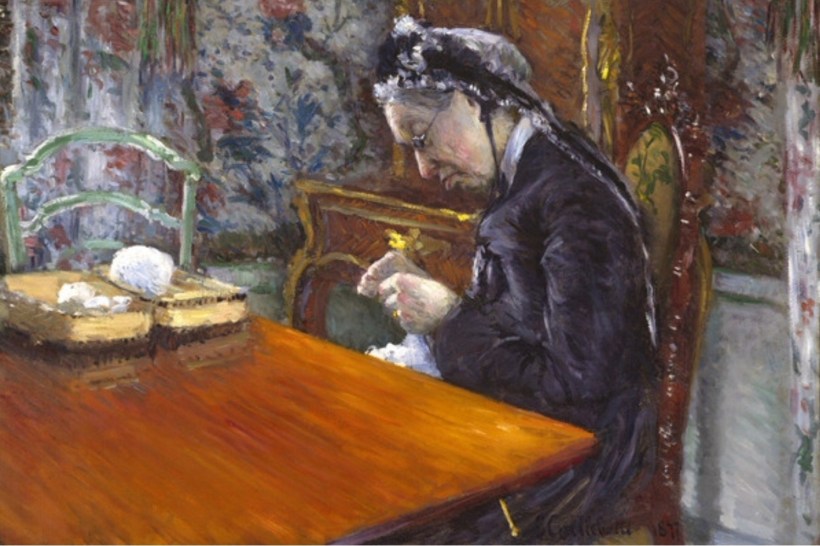
Mademoiselle Boissière

“. . .roses dizzied her with summer. . .”

Ekphrasis is poetry is based on works of art.  I love this kind of writing.  This poem is based on “Mademoiselle Boissière Knitting” by Gustave Caillebotte.

img_1922

She sits alone
knitting for Sophie’s baby,
expected in the spring.
She doesn’t think of Sophie baring
herself for a man, as she did once,
when roses dizzied her with summer,
how easy her petticoats lifted, how
afterwards they smelled of blood
and sweat, how she stumbled,
pushed the bolt to lock the door,
how those smells return
when she sees him in the square,
squiring his wife on errands
and feels her heart loose
in its stays.

– Sarah Russell
First published in Ekphrastic Review

Ravens

“. . .an avian funeral cortège.”

The smartest man I know is dying –
cancer, spreading to his bones
and cruelly, to his brain.

“Come look back here,” he says when I visit.
“They knew even before I did.”
Six ravens walk – stately, slow, with purpose –
across his yard, an avian funeral cortège.
“They’ve been here since spring,” he adds.

He points to a corner near the fence.
“That one has a broken wing.
Got it robbing a blue jay’s nest.
Shouldn’t mess with jays, I told her.”

He feeds her raw chicken and steak but says he knows
that soon she’ll ask for death, and he’ll oblige.
“They won’t do the same for me,” he says.
“Fucking do-gooders.”
I don’t know what to say.

“When she’s gone, her fellows will have
a feast of her carcass,” he says without malice,
“just as they will with mine.”
I try to protest, but I know it’s true.
Already there’s talk that his research is passé.

At lunch, I see my own reflection in a soup spoon.

– Sarah Russell
First published in Misfit Magazine