Hegira

Those dream-filled summer nights,
a wail, anguished as a banshee,
pierced the rusty screen.
Then the rhythmic clatter grew
until the bed and I would tremble.

Let me come too, I whispered,
but it never heard,
or didn’t understand,
or didn’t care about a little girl
and a gallant torn-eared bear.

The rumbling, shaking wraith
moved on, its cry waning to an echo,
my heartbeat clinging to the cadence
of away from here, away from
here, away

– Sarah Russell
First published in Black Poppy Review

Montana Man

“. . .the sky’s wide and blue and bare. . .”

Another ekphrastic poem today, based on a photograph by Tom Klassy.

He squints from under a John Deere cap
even when there is no sun. It’s late fall now,
the hay — enough this year — baled
for January feeding if the pickup makes it
to the herd — huddled, wooly, steamy breath
to match his own, pitch fork separating clouds
of gold, strewing it like loaves and fishes —
that kind of pride, though pride’s a wobbly perch
when drought and blight’s the norm, when the pickup
needs a fuel pump, barn needs shingles.

But this morning, the sky’s wide and blue
and bare, and Waylon’s singing Ramblin’ Man
while he hums along. Bernice’ll have coffee
scalding hot at the cafe, and prices were up
on the farm report this morning. Folks and steers
ain’t so different, he reckons, herd gathering,
keeping with their kind.

– Sarah Russell
First published in Ekphrastic Review

At JCPenneys

“. . .a shared women’s intimacy.”

In honor of all us imperfect mothers…

I back through the door of the ladies room
pulling stroller, wailing baby, all his gear
(not a graceful entrance) into the anteroom
adjacent to wash basins and toilet stalls.
I gather his indignant, thrashing form,
my impatience nearly matching his,
and perch on the cracked Naugahyde settee.

Dammit. What bad timing. This twenty minutes
means rush hour traffic going home.
I sling a receiving blanket over my shoulder,
and squalls turn to contented gurgles.

Only then do I notice the frail, ancient figure
in a chair nearby, her cane leaned carefully beside her.
I smile, apologetic for intrusion, her catching me
at not-my-best-mom self, my feeling
of nakedness under the scrap of flannel.

Her face is soft with wrinkles and surprise.
“Oh my, you’re nursing your baby,” she says.
“I didn’t think girls did that anymore.”
I tell her it’s become the norm,
that studies show it’s healthier.
“Do you mind if I sit here with you?” she asks.
I assure her it will be all right.

We are alone, the restroom quiet
on a Tuesday afternoon,
save for soothing baby sounds.
I relax, change sides, let the blanket slip
in a shared women’s intimacy.
Finally the baby breaks away, eyes closed,
still suckling in his sleep. “I nursed seven babies,”
she tells me then. “If I close my eyes,
I almost remember what it feels like,
having a baby at my breast.”

I can’t speak, overwhelmed
by the miracle of milk.

– Sarah Russell
First published in The Houseboat
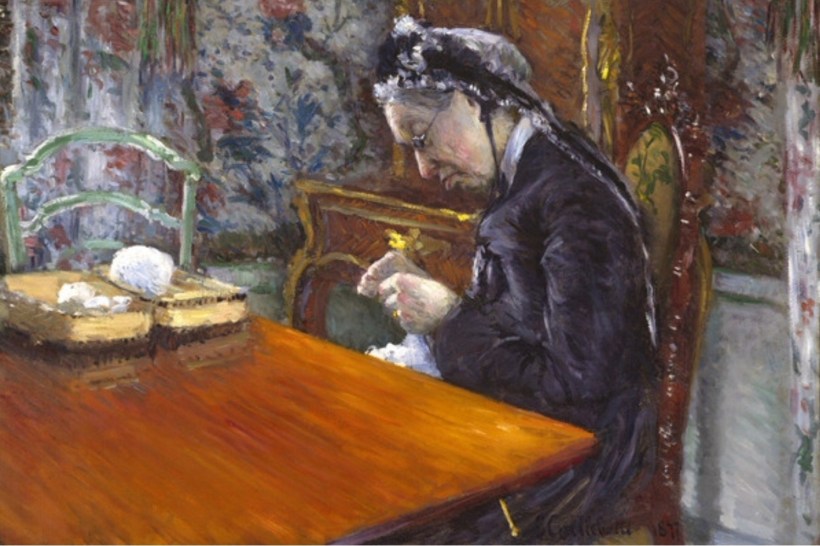
Mademoiselle Boissière

“. . .roses dizzied her with summer. . .”

Ekphrasis is poetry is based on works of art.  I love this kind of writing.  This poem is based on “Mademoiselle Boissière Knitting” by Gustave Caillebotte.

img_1922

She sits alone
knitting for Sophie’s baby,
expected in the spring.
She doesn’t think of Sophie baring
herself for a man, as she did once,
when roses dizzied her with summer,
how easy her petticoats lifted, how
afterwards they smelled of blood
and sweat, how she stumbled,
pushed the bolt to lock the door,
how those smells return
when she sees him in the square,
squiring his wife on errands
and feels her heart loose
in its stays.

– Sarah Russell
First published in Ekphrastic Review

Ravens

“. . .an avian funeral cortège.”

The smartest man I know is dying –
cancer, spreading to his bones
and cruelly, to his brain.

“Come look back here,” he says when I visit.
“They knew even before I did.”
Six ravens walk – stately, slow, with purpose –
across his yard, an avian funeral cortège.
“They’ve been here since spring,” he adds.

He points to a corner near the fence.
“That one has a broken wing.
Got it robbing a blue jay’s nest.
Shouldn’t mess with jays, I told her.”

He feeds her raw chicken and steak but says he knows
that soon she’ll ask for death, and he’ll oblige.
“They won’t do the same for me,” he says.
“Fucking do-gooders.”
I don’t know what to say.

“When she’s gone, her fellows will have
a feast of her carcass,” he says without malice,
“just as they will with mine.”
I try to protest, but I know it’s true.
Already there’s talk that his research is passé.

At lunch, I see my own reflection in a soup spoon.

– Sarah Russell
First published in Misfit Magazine

Who put Bella in the Wych Elm?

Another reblog today from Ryan Stone’s Days of Stone blog. Ryan’s poem is based on an actual event, which makes it even more eerie.

Maybe you remember I praised the Poppy Road Review venue yesterday. This poem was published on Poppy Road’s sister site, Black Poppy Review, where poetry takes a turn toward the macabre. Click at the bottom of the poem to visit this beautiful, if chilling, collection of poems.

Family Photo, 1899

To end April’s National Poetry Month, here’s a wonderful portrait written by award winning poet Joan Colby.  Joan’s latest poetry collection is The Seven Heavenly Virtues.  Learn more about Joan and her poetry here.

Five daughters, every one with hair
To her hips. Cumbersome dresses
Meant for Sundays. No one is smiling.
The mother’s hair skinned into a thick bun.
The smallest child on her lap. The father
Gallant with sideburns, chin whiskers,
A wave over one eye. Cravat and
Polished boots. That they lived, all of them,
In a one-room log cabin in the Uinta Mountains
Is not apparent, dressed in their finest, hair
Freshly washed and brushed so that
Every girl could be Rapunzel.
Two infant sons already buried.
The father will die by gunfire
At the age of 40. The mother will be nursing
Her last child: my father
Who will be photographed later
In a white lace baptismal gown.

– Joan Colby
First published in Poppy Road Review

P.S. New prompts are up on the Prompts page.

He Is Six and She Is Three

Danny Earl Simmons provides a devastating child’s perspective on family in this poem.  I follow Dan’s blog so I don’t miss any of his poems when they are published.  (I’m a fan!)  His new chapbook is The Allness of Everything.  You can learn more about him and his poetry here.

He is six and she is three
when they’re sent to spend what’s left
of their innocence with their aunt,
the older sister of their now-dead mother –

beaten to death with the fists
of their now-imprisoned father
who loved them both with a rage

so red his bare knuckles bled
into their screaming mother’s face
until there were no screams left

while the six-year-old brother held
his three-year-old sister curled
all the way under the bottom bunk

as she sobbed until there was breath enough
to ask why their mommy just won’t be good
and why isn’t he crying, too.

– Danny Earl Simmons
First published in Eunoia Review


what i did in the war

“. . .keeping the company of ghosts. . .”

Matt Borczon says he didn’t fight during the war in Afghanistan, but he’s fighting in its aftermath.  You can read more about this fine poet and his chapbook A Clock of Human Bones here.

it’s hard
to explain
to civilians
that my
gun was
locked up
in an iso
container
for the
whole time
I was
in Afghanistan
that I
did not
fight this
war I
worked in
a hospital
at the
craziest
point of
the war
but no
I did not
fight the
war
I watched
it from
the distance
of a
severed arm
watched through
the holes in
marines chests
and stomachs
through the
eye sockets
of children
shredded by
hellfire helicopters
but I
did not
fight the
war
I prepared
gauze for
wounds and
vacuums to
suction blood
I cleaned
dead bodies
for coffins
for planes
for home
for broken
families
I bleached
mattresses
between patients
and served
meals to
soldiers with
no hands
to eat with
but I
did not
fight the
war
I searched
for missing
limbs and
spoke with
angry village
elders and
was hit
by an
Afghan prisoner
for trying
to help
him stand
but I
did not
fight the
war
and it
wasn’t until
I was in
Kuwait at
a stress
debriefing
that I
ever heard
the words
compassion fatigue
or secondary PTSD
so I came home
unaware of
how it
would feel
to hear
helicopters
at night
or how
nightmares
could make
me soak my
sheets with
sweat and
how panic
would make
me ruin
my children
or how I
could lose
days upon
days in
memories
keeping
the company
of ghosts
fantasizing
about my
own death
in order
to feel
like an
end was
in sight
but I
did not
fight the
war
I inhabited
the war
was forced
by blood
to adapt
by death
to adapt
by shock
and awe
to adapt
until the
day they
sent me
home with
no gauze
no bleach
no morphine
pump no
tool or
instructions
to readjust
to turn
it off
to forgive
or forget
so no
I did
not fight
the war
but I
am still
fighting
every single
day

– Matt Borczon
First published in Fried Chicken and Coffee

The Wake Up Call

Jimmy Pappas was instrumental in introducing me to a cadre of wonderful poets through Goodreads who commiserate, critique one another’s work, and share common goals in our writing.  Jimmy is a Vietnam vet who will publish two books of poetry this year about his time in Vietnam.  Jimmy told me the poem I chose to share is one of the first ones he published.  You can learn more about Jimmy Pappas and his poetry here.


When it was time
to wake me up
to go fishing,

he stood at the end
of the bed and held
my foot in his hands

as if it were a piece
of crystal, the way
he must have done

when I was a baby,
but I was too tired
to wake up and

too young to understand
how much he needed
me to be his son.

– Jimmy Pappas
First published in Poetry Breakfast